- Reviewed by
- Crypto.Andy
- Fact checked by
- Vlad Anderson

- Date
- Views
- 0
- Reading time
- 10 min.
What Is Take Profit in Trading?
Key takeaways:
- Take Profit is a tool for automatically closing a position when a specified price level is reached. The trigger price may differ from the execution price.
- How to calculate Take Profit: consider the entry price, position direction, trading strategy, and risk-to-reward ratio.
- Take Profit vs. Stop Loss: the former locks in the result when the price moves favorably, while the latter limits losses when the price moves against the position.
- What affects execution: volatility, liquidity, and slippage. An order may be executed at a price different from the specified level.
- How to choose a Take Profit level: use technical and fundamental analysis, considering support and resistance levels, price movements, and market factors.
- How to use Take Profit and Stop Loss together: set profit-taking and loss-limiting levels according to a trading plan.
What Is Take Profit?
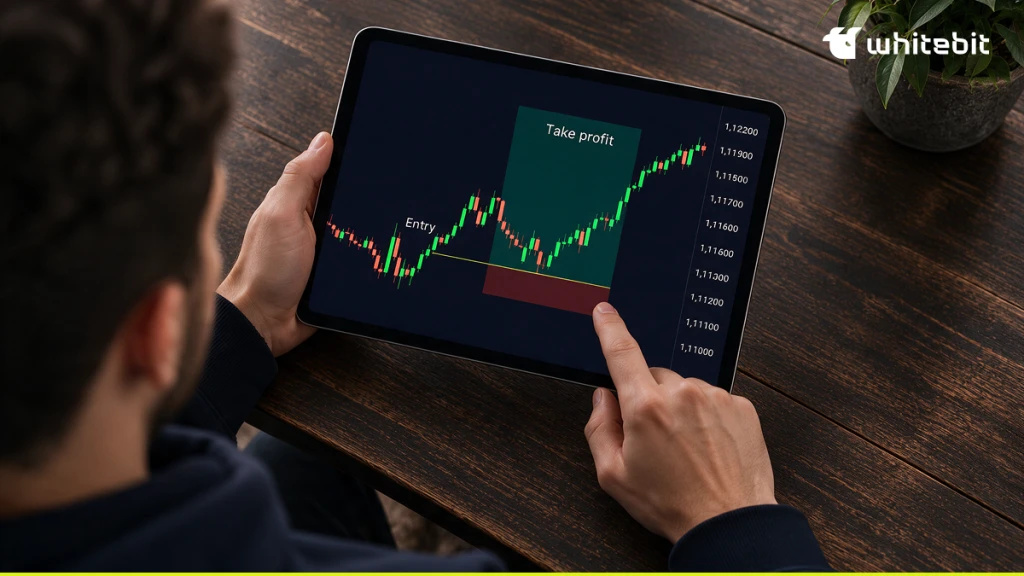
Take Profit is a condition that, when met, triggers the process of closing a trading position at a predetermined price level. This tool is used to automate exits from trades and lock in results without having to monitor the market manually when the target price is reached.
For a long position, the Take Profit level is typically set above the entry price. For a short position, the target level is set below the entry price. For example, if an asset is purchased at 100 USDT, Take Profit may be set at 110 USDT. When the Take Profit trigger condition is met, the system initiates the closing of the specified position volume.
It is important to distinguish between the trigger condition and the actual execution price. During sharp market movements, the price may change between the moment the specified level is reached and the execution of the order. Therefore, Take Profit does not guarantee that a position will be closed at the exact specified price or that a particular amount of profit will be earned.
How Does Take Profit Work?
The Take Profit mechanism depends on the order type and the rules of the trading platform. Generally, a price condition and position volume are specified first, after which the system monitors the market. When the price reaches the specified value or the relevant condition is met, the position-closing process is initiated.
For a long position, the condition typically triggers when the price rises to the target level. For a short position, it triggers when the price falls. If only part of a position needs to be closed, the corresponding volume is specified. With multiple exit levels, a position can be closed gradually.
Order types are important here because the execution method depends on the type of order used. In one case, reaching the trigger price may result in the creation of a market order; in another, it may lead to the placement of a limit order or another supported execution mechanism. Therefore, triggering and execution rules must be considered in relation to the specific order type.
The Take Profit mechanism depends on the order type and the rules of the trading platform. When the specified price level is reached, the system initiates the closing of the entire position or part of it. If several Take Profit levels are set, the position can be closed in stages.
The execution method depends on the order type. When Take Profit is triggered, a market or limit order may be created. Market orders are subject to slippage, while limit orders do not guarantee execution.
The Take Profit mechanism involves more than simply comparing the current price with a specified value. It is also necessary to consider the order type, available volume, market conditions, and how the trading system processes the exit condition.
How to Set Take Profit?
Setting Take Profit depends on the trading interface, position type, and order used. For a long position, the target level is typically set above the entry price, while for a short position, it is set below. The level is selected based on the trading plan and market structure.
Take Profit allows a position to be closed either fully or partially. For example, with a position of 1 BTC, 0.5 BTC can be closed at the first target level and the remaining 0.5 BTC at the second. Before placing an order, traders also consider the minimum order size, permitted price increments, and other restrictions associated with the trading instrument.
Technical analysis can be used to select a target level, including historical price levels, support and resistance zones, and volatility indicators. Fundamental analysis may also be applied to longer-term positions. A trailing mechanism can also be used to lock in profits as the market moves, provided that the trading platform supports this functionality.
How to Calculate Take Profit?
One method of calculating Take Profit is based on the risk-to-reward ratio (Risk/Reward Ratio). For example, with a ratio of 1:2, the potential profit is twice the amount at risk.
For a long position:
- Entry price — 100 USDT.
- Stop Loss — 95 USDT.
- Risk per unit of the asset — 5 USDT.
- Take Profit at a 1:2 ratio — 110 USDT.
For a short position:
- Entry price — 100 USDT.
- Stop Loss — 105 USDT.
- Risk per unit of the asset — 5 USDT.
- Take Profit at a 1:2 ratio — 90 USDT.
This calculation helps determine a target level but does not guarantee that the price will reach it. Therefore, support and resistance zones, volatility, and other market factors are also considered when choosing a Take Profit level. To calculate Stop Loss and Take Profit, the acceptable risk and Stop Loss level are determined first. The target level is then calculated based on the selected risk-to-reward ratio.
Take Profit and Stop Loss
Take Profit and Stop Loss are used for different position exit scenarios. The former is designed to lock in the result when the price moves in the expected direction, while the latter is intended to limit losses when the price moves against the position.
What are Stop Loss and Take Profit? They are two related but opposite position management tools that help establish exit conditions before a trade is closed.
| Criterion | Take Profit | Stop Loss |
| Primary function | Locking in the planned result | Limiting losses |
| Trigger condition | Reaching the target price level | Reaching the loss-limiting price level |
| Combined use | Sets the target exit level | Sets the exit level for unfavorable price movements |
Stop Loss and Take Profit are tools that help define the conditions for closing a position in advance, but they do not guarantee execution at the exact specified price. The outcome depends on liquidity, the speed of price movements, and the order type.
Stop Loss and Take Profit can be set simultaneously for the same position to establish both potential exit scenarios. If one order closes the position, the other must be canceled or become inactive according to the trading system’s mechanism.
Take Profit and Stop Loss are also used to evaluate the relationship between potential risk and reward. For example, if the distance from the entry price to Stop Loss is 5%, while the distance to Take Profit is 10%, the risk-to-reward ratio is 1:2. However, this ratio does not guarantee that the target level will be reached and does not constitute a trading strategy on its own.
Advantages and Disadvantages of Take Profit
Take Profit simplifies the management of an open position, but its use involves certain limitations that should be considered when selecting an exit level.
Advantages:
- Automated exits. Take Profit initiates the closing of a position when the specified level is reached, reducing the need to monitor the market continuously.
- Partial profit-taking. When multiple targets are used, a position can be closed in stages by distributing its volume across different price levels.
- Trading plan discipline. A predetermined exit price reduces reliance on decisions made during market movements. However, the selected level must still be supported by the trading strategy.
Disadvantages:
- No guarantee of reaching the target. The price may reverse before reaching the specified level, meaning the position may not be closed through Take Profit.
- Further price movements are not captured. Once a position has been fully closed, subsequent price increases or decreases no longer affect its result.
- Possible execution price deviations. During periods of high volatility or low liquidity, the trigger price may differ from the actual execution price due to slippage.
- No universal target level. The target price depends on the trading strategy, position direction and holding period, market conditions, and acceptable risk. Take Profit automates a predefined exit scenario but does not determine that scenario for the trader.
Conclusion
Take Profit is a tool that automates exits from trading positions when a predetermined price condition is met. It can be used to close a position fully or partially and is one of the components of trade management. Using Take Profit and Stop Loss together allows traders to define the main potential exit scenarios in advance, but it does not eliminate market risks.
This information does not constitute financial or investment advice.
Share to
Published by