- Date
- Views
- 2
- Time
- 10 min.
What Is TPS (Transactions Per Second) In Crypto?

Key Takeaways
- TPS (Transactions Per Second) measures how many transactions a blockchain can process in one second, making it a key indicator of network performance.
- Blockchain TPS depends on factors such as block time, block size, consensus mechanism, and network architecture.
- Higher TPS improves scalability by enabling faster transaction processing and supporting high-demand applications like DeFi, gaming, and payments.
- Theoretical TPS differs from real-world throughput, which can be affected by network congestion, transaction complexity, and validator performance.
- TPS should not be evaluated in isolation—security, decentralization, transaction finality, and network reliability are equally important when assessing a blockchain.
What Is Transactions Per Second?
Transactions Per Second (TPS) is a metric that measures the number of transactions a blockchain network can process in one second. It is one of the key indicators of blockchain performance and scalability, reflecting how efficiently a network handles user activity and transaction demand.
A higher TPS generally means faster transaction processing and better support for high-volume applications such as payments, DeFi, and blockchain gaming. However, TPS should not be evaluated in isolation, as real-world network performance also depends on factors such as transaction finality, decentralization, and security.
How TPS Works in Blockchain?
Transactions Per Second measures how many transactions a blockchain network can validate and process within one second. When users submit transactions, they are broadcast to the network, grouped into blocks, verified by validators or miners, and added to the blockchain. The number of transactions included in each block and how quickly new blocks are produced determine the network’s TPS.
Several factors influence TPS, including block size, block time, consensus mechanism, and network architecture. Blockchains with shorter block intervals, larger block capacities, or parallel transaction processing can achieve higher TPS, allowing them to handle greater transaction volumes with lower latency.
Why Does TPS Matter?
Several factors explain why TPS is an important metric for evaluating blockchain performance:
- Determines network scalability by showing how many transactions a blockchain can process per second.
- Reduces congestion during periods of high network activity.
- Improves transaction speed by enabling faster processing and confirmation.
- Supports high-volume applications such as DeFi, blockchain gaming, NFT marketplaces, and payment networks.
- Enhances user experience with lower latency and smoother network performance.
- Reflects overall network efficiency, although it should be evaluated alongside security, decentralization, and transaction finality.
How to Calculate Blockchain Transactions Per Second?
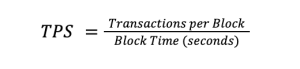
Blockchain TPS is calculated by dividing the number of transactions included in a block by the average time required to produce that block.
Transaction per second calculation formula:
Example:
- Transactions per block: 2,000
- Block time: 2 seconds

Blockchain TPS Comparison
The blockchain transactions per second comparisontable shows the approximate theoretical TPS of the most widely used Layer 1 blockchains.
| Blockchain | Consensus | Theoretical TPS | Block Time |
| Bitcoin | Proof of Work (PoW) | ~7 | ~10 min |
| Ethereum | Proof of Stake (PoS) | ~15–30 | ~12 sec |
| Solana | Proof of History (PoH) + PoS | Up to 65,000 | ~400 ms |
| Avalanche | Avalanche Consensus (PoS) | Up to 4,500 | <2 sec |
| Cardano | Ouroboros PoS | Up to 250 | ~20 sec |
Future TPS Improvements
Blockchain networks continue to improve transaction throughput through innovations in scalability and network architecture. Technologies such as Layer 2 solutions, sharding, parallel transaction processing, and more efficient consensus mechanisms are designed to increase TPS in crypto while maintaining security and decentralization. As these technologies mature, future blockchains are expected to handle significantly higher transaction volumes with lower costs and faster confirmation times.
Advantages and Limitations of TPS
TPS is a useful metric for evaluating blockchain performance, offering several key benefits:
- Measures blockchain performance by showing how many transactions a network can process per second.
- Enables network comparisons between different blockchain platforms.
- Reflects scalability and the ability to support growing user demand.
- Helps evaluate suitability for high-volume applications such as payments, DeFi, gaming, and NFTs.
Despite its importance, TPS does not provide a complete picture of a blockchain’s overall performance. Its main limitations include:
- Does not measure transaction finality.
- Ignores transaction complexity.
- May represent theoretical rather than real-world performance.
- Should be evaluated alongside security, decentralization, network reliability, and transaction costs.
The Bottom Line
Сrypto transactions per second is one of the most widely used metrics for measuring blockchain performance and scalability. While a higher TPS generally indicates greater transaction throughput, it should not be considered in isolation. Factors such as security, decentralization, transaction finality, and network reliability are equally important when evaluating a blockchain. Understanding TPS alongside these metrics provides a more complete picture of a network’s overall capabilities.
This content is for informational and educational purposes only and does not constitute financial, investment, or trading advice.
To Share
Published by
 WhiteBIT