- Date
- Views
- 5
- Time
- 10 分钟.
What Is A Honeypot In Crypto?

Key takeaways:
- A honeypot is a cryptocurrency trap where a user can buy or receive a token but cannot properly sell or transfer it.
- Restrictions are usually embedded in the smart contract and may include blocked sales, blacklists/whitelists, high fees, or other hidden conditions.
- You can check a token before buying it — for example, by reviewing the contract and actual sell transactions, as well as using honeypot scanners.
- Recovering funds after falling into a honeypot is impossible, so the main protection is to check unknown tokens before interacting with them.
What Is A Crypto Honeypot?
A honeypot is a token or smart contract whose logic allows a user to buy or receive an asset but intentionally blocks or makes its subsequent sale or transfer economically unfeasible.
Why “honeypot”? The word acts as bait — a user can easily “get in” by buying the token, but due to restrictions embedded in the contract, they can no longer get out, meaning they cannot sell the asset and recover their funds.
How Honeypots Work?
Technically, a honeypot can be implemented in several ways: the contract may reject sales through a revert, allow them only for certain whitelisted addresses, add buyers to a blacklist, impose an extremely high sell tax, or dynamically change the rules after the token is launched.
At the same time, everything may look like a normal market from the outside: purchases go through, liquidity is available, and the price rises. This creates the appearance of normal trading and may trigger FOMO (fear of missing out), encouraging new users to buy the token without thoroughly checking it. Meanwhile, only the project creators or addresses associated with them may be able to sell the asset successfully.
In simplified terms, the scheme works like this: a user buys the token → funds enter the pool → the tokens arrive in their wallet → the user submits a sell transaction → hidden contract logic blocks the sale or makes it economically pointless.
Types Of Crypto Honeypots
Technically, honeypots can be conveniently categorized by the mechanism that prevents users from exiting their positions:
- Sell-block honeypot — the classic type. Users can buy the token, but when they attempt to sell it, the contract triggers a revert or otherwise prevents the transaction from being executed.
- Whitelist/blacklist honeypot — the contract checks the user’s address. For example, only whitelisted addresses controlled by the creator may be allowed to sell, or a buyer’s address may be added to a blacklist after purchase, preventing them from transferring or selling their tokens.
- High-tax honeypot — selling is technically allowed, but the contract imposes an extremely high fee, sometimes close to 100%. The transaction may go through, but the user receives only a negligible fraction of the asset’s value back.
- Dynamic-tax honeypot — the fee can be changed by the contract owner or automatically. Initially, the token may pass checks and be sold normally, but the sell tax can later increase sharply.
- Transfer-restriction honeypot — restrictions are embedded directly into the transfer/transferFrom logic. The contract may check the sender, recipient, transaction amount, block, time, or other parameters and allow transfers only under certain conditions.
- External-contract honeypot — suspicious logic is moved to another contract. The token’s main code may look relatively normal, but before a transfer, it calls an external contract that decides whether to allow or block the transaction.
There are also hybrid honeypots that combine several mechanisms. For example, the owner may control both a blacklist and a dynamic fee.
Honeypot vs. Rug Pull
The main difference between a rug pull and a honeypot lies in how the scam works. In a honeypot, users can buy the token but cannot properly sell or transfer it because of restrictions in the smart contract. In a rug pull, selling may still be possible, but the project’s creators withdraw liquidity, sell large amounts of their own tokens, or otherwise extract funds from the project, causing the asset’s value to collapse.
Well-known Examples Of Honeypot Attacks
Several real-world cases involving honeypotted crypto scams:
- Squid Game Token (SQUID) — the most famous example. In 2021, the token, which had no official connection to the Squid Game series, surged in price, but many buyers were unable to sell it. The creators later withdrew the funds, and SQUID’s value dropped to nearly zero.
- SnowdogDAO (SDOG) — a project launched on Avalanche in 2021. Ahead of a planned buyback, SDOG’s price surged, but the mechanics of the trading system allowed several addresses to exit their positions with enormous profits, while other holders were effectively trapped in a rapidly depreciating asset.
- Narwhal (NAR) — a more recent example from 2025. The token was promoted through major Telegram channels and identified as a honeypot: users could buy NAR but could not properly sell it. The investigation also identified the specific address of the malicious contract.
- Fake Sentient Coin (SEN) — another specific case of honeypotting from 2025. The fake SEN token was traded via Uniswap and impersonated Sentient Coin. A user who bought the token discovered that they could not sell it; subsequent checks of the contract using several tools classified it as a honeypot.
How To Get Out Of Honeypot Crypto?
Before buying a little-known token, it is worth performing at least a basic check. Pay attention to the following:
- Check the token with a honeypot checker. Paste the smart contract address into Honeypot.is — the service simulates buying and selling and helps detect restrictions and suspicious fees.
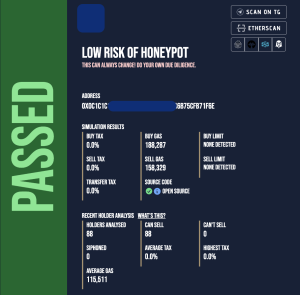
Example of a token analysis. Source: https://honeypot.is/
- Use several services. For example, you can additionally check the contract with Token Sniffer, which analyzes tokens and assigns them a risk score.
- Check actual sales. Use a blockchain explorer or DEX to make sure the token is not only being bought but also successfully sold by regular users.
- Pay attention to fees. A high or adjustable sell tax can make selling the token economically unfeasible.
- Review the contract functions. The owner’s ability to add addresses to a blacklist, restrict transfers, or change fees increases the honeypot risk crypto.
- Check token distribution and liquidity. A large share of the supply held by a few connected wallets and a small liquidity pool are additional red flags.
- Do not treat a successful check as a guarantee of safety. Some contracts allow the owner to change settings after the token has passed its initial checks.
Conclusion
The main danger of a honeypot is that the problem often becomes apparent only when you try to sell the token. This is why the principle of DYOR (Do Your Own Research) is especially important here — check the asset yourself before buying it: review the contract and transactions, examine the fees, and use specialized scanners. A few minutes spent on these checks can help you avoid a situation where exiting your position is no longer possible.
This material is provided for informational purposes only and does not constitute financial or investment advice.
To Share
Published by
 Paul Bennett